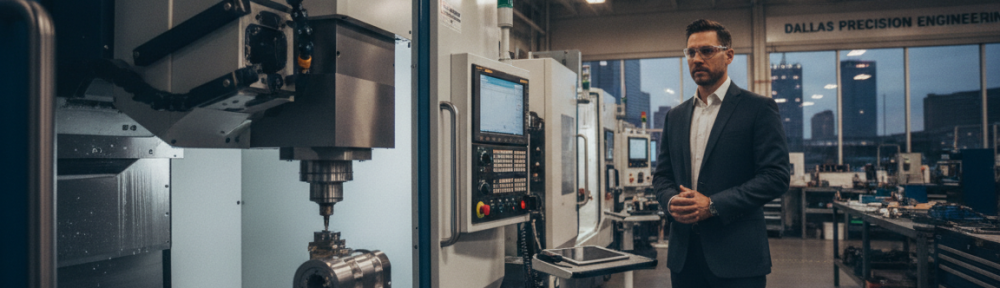
Aerospace, medical-device, and industrial manufacturers depend on precision machining to produce reliable parts with exact dimensions and repeatable performance. Through CNC lathe machining in Dallas, suppliers can achieve close dimensional limits, uniform finishes, and reliable production output. Such precision lowers the frequency of rework, limits scrap, and minimizes costly production interruptions. Advanced shops use a combination of multi-axis mills, precision lathes, EDM machines, waterjets, and laser-cutting equipment. Using multiple technologies under one roof makes it easier to manufacture complicated shapes while limiting fixture changes and repeated setups. These efficiencies shorten machining cycles and improve quality for engine hardware, aircraft landing-gear parts, and electronic housings.
Strong regional visibility helps Dallas machine shops demonstrate capability, establish trust, and connect with prospective clients and workers. Manufacturers regularly share production images, machining footage, project summaries, and finished components through Instagram and similar platforms. The strategy generates customer interest and supports recruitment of experienced operators and technical personnel across the local CNC sector.
Real-world implementations such as Paramount Machine’s adoption of Datanomix demonstrate how Automated Production Intelligence can improve manufacturing visibility. The platform connects directly with production equipment and reveals actual machine activity, utilization, downtime, and operating trends. This transparency helps machining services in Dallas prepare more accurate quotations, shorten cycle times, uncover unused capacity, and improve profitability.
The following case study examines machinery, materials, workflow changes, and commercial outcomes that can be applied in real operations. Its primary focus is on practical changes that Dallas industrial machine shops and surrounding manufacturers can implement within their own facilities.
Overview Of The CNC Lathe Machining Dallas Case Study
The case study examines how precision CNC lathe machining supports demanding manufacturing programs throughout Dallas. Particular attention is given to sectors that depend on complex geometries, demanding dimensional limits, and consistent production results. The review considers machine selection, process controls, material-handling practices, tooling decisions, and the integration of production-monitoring technology. Together, these methods strengthen quoting, increase productive machine time, and improve operational performance. Social-media examples and customer testimonials provide evidence of practical results and reinforce the machining partner’s credibility.
Objectives And Scope Of This Machining Review
The central goal is to demonstrate that standardized machining procedures can minimize material loss and shorten delivery times for important parts. Covered areas include machining setups, inspection protocols, operational measurements, and methods for continuous process refinement. Special attention is given to tracking cycle times, tooling longevity, equipment use, and material movement across both development and full-production runs.
Dallas Industries Served: Aerospace, Defense, Medical, Automotive, And Industrial
Aircraft engine hardware, landing-gear assemblies, and avionics enclosures often depend on extremely precise machining measured at the micron level. Military and defense components require strength, complete manufacturing traceability, and documented process consistency. Medical manufacturing demands biocompatibility, dimensional precision, and finishes suitable for demanding clinical applications. Vehicle and industrial markets commonly focus on higher-volume manufacturing, process reliability, and cost efficiency.
 Custom Mold Services Dallas
Lowrance Machine Profile And Local CNC Machine Shop Services
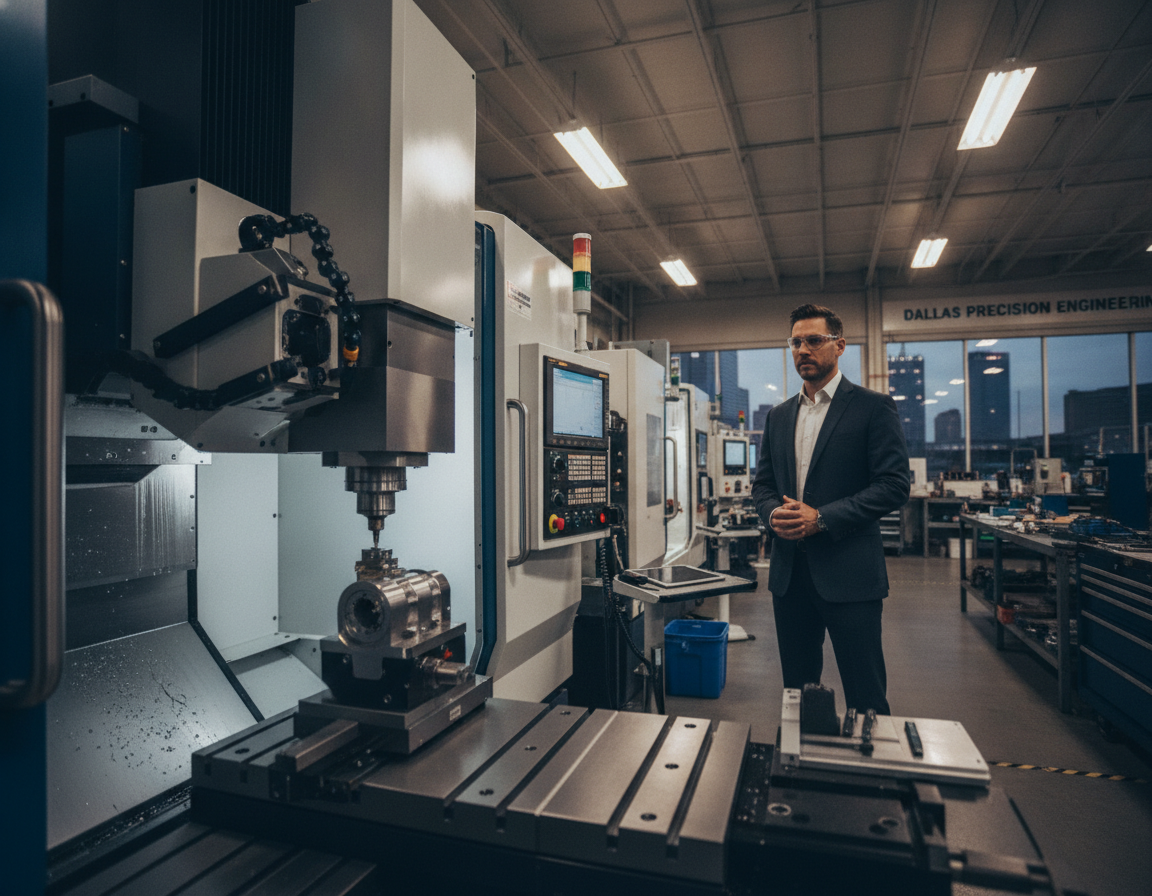
Through CNC milling, precision turning, and Datanomix monitoring, Lowrance Machine supports Dallas customers with improved manufacturing visibility and equipment performance. The shop offers advanced turning, multi-axis machining, modern tooling, and scalable production methods for both prototypes and repeat-volume orders.
| Capability | Primary Benefit | Typical Use |
|---|---|---|
| Advanced multi-axis machining | Complex surfaces completed with fewer fixtures and machining operations | Well matched to avionics housings, implant parts, and contoured products |
| High-precision lathes | Reliable concentricity and smooth finishes across repeated production | Important for engine hardware and precision shaft production |
| Tooling for specialty fasteners | Repeatable machining of specialized threads and fastener heads | Supports made-to-order fasteners, threaded components, and assembly systems |
| Real-time production intelligence | Continuous tracking of equipment activity and production efficiency | Improves quotation accuracy for a CNC machine shop Dallas provider |
| In-process and final inspection resources | Production checks supported by optical systems and coordinate measurement | Supports regulated components requiring documented dimensional accuracy |
| Custom part workflows | Flexible quantities covering development parts through full production | Supports scalable Dallas custom-fastener and specialty-part production |
Technical Capabilities And Equipment In Dallas Machine Shops
Dallas machine shops use advanced mills, turning centers, inspection equipment, and skilled bench work to satisfy demanding aerospace and industrial requirements. These shops combine sophisticated CNC technology with traditional machining knowledge to handle development work, corrective repairs, and production quantities. Live production intelligence enables planners to align machines with current demand and minimize unnecessary downtime.
Benefits Of 5-Axis Machining For Complex Dallas Components
Advanced multi-axis machines move tools and workpieces across several directions simultaneously, reducing setups for intricate aircraft parts. Machining multiple faces without removing the workpiece improves alignment, limits fixtures, and supports consistent finishing. Five-axis machining allows Dallas manufacturers to reduce operator handling and preserve alignment on precisely contoured components.
CNC Lathe Machining In Dallas: Equipment, Tooling, And Accuracy
Premium turning centers and live-tool lathes support accurate machining of difficult alloys such as titanium and stainless steel. Shops use precision workholding, hydraulic clamping, and replaceable inserts to maintain consistency during extended manufacturing cycles. Successful CNC lathe machining in Dallas depends on thermal compensation, rigid machine construction, controlled workholding, and proactive tool-wear management.
Integrating CNC Milling And Manual Machining In Dallas
Computer-controlled milling systems in Dallas handle complex pockets and tight geometric details efficiently. Traditional manual machining continues to support custom fixtures, single components, repair work, and small fitting corrections. Using CNC and manual processes together allows manufacturers to transition efficiently from prototype work to production without losing dimensional control. Dallas providers combining CNC production with skilled hand finishing are well positioned to shorten turnaround on specialized and limited-quantity orders.
Improving Machining Processes And Production Performance
Meaningful improvements in precision-machine shops often result from numerous carefully planned adjustments rather than a single major change. Typical changes involve better tool arrangements, updated coolant strategies, stronger workholding, and more efficient multi-axis programming. The objective is to shorten machining cycles without sacrificing tolerance control, surface quality, or process reliability. This approach increases throughput for machining services in Dallas and for specialized work performed within CNC machine shops.
Shorter machining cycles require fewer workholding changes and better optimized cutting movements. Programmers use dynamic cutting parameters, efficient chip clearing, and coordinated operations on five-axis equipment. These practices reduce noncutting movements, unnecessary pauses, and manual handling. By measuring spindle hours and downtime, planners can identify idle equipment and shift production accordingly.
Automated production intelligence provides immediate visibility into actual shop-floor performance. Live reporting systems capture production speed, idle events, delay reasons, historical jobs, and equipment activity. With detailed operating information, providers can refine pricing, understand job expenses, and eliminate margin-reducing inefficiencies.
Production data reveals recurring interruptions associated with coolant servicing, worn tools, missing materials, and process waiting time. Shops may introduce preventive tool swaps, more effective coolant strategies, and updated process controls to protect part quality. The same data informs decisions about outsourcing work or keeping it inside a local CNC machine shop in Dallas.
Contemporary inspection systems use in-process sensors to detect mistakes before defective parts accumulate. Integrated cameras verify that parts are loaded correctly and that key features exist during setup and ongoing runs. Before downstream work begins, laser profilers can confirm essential shapes, surfaces, and diameters. Coordinate measuring machines provide final dimensional confirmation for selected production samples and completed lots.
Combining inline and final inspection prevents defects from spreading and helps maintain regulated-industry requirements. Reliable workflows limit unplanned production failures and support organized Dallas industrial-machine repair when hardware faults occur.
Maintenance personnel analyze operating trends to perform timely service and preserve equipment uptime. Automated alerts identify emerging concerns such as spindle instability, coolant-quality problems, and worsening machining performance. Early warnings allow Dallas industrial-equipment repair specialists to intervene before complete failure or permit specific parts to be replaced. Integrating real-time intelligence with maintenance practices stabilizes production and supports dependable delivery schedules.
Specialty Components, Materials, And Dimensional Requirements
Dallas machine shops process a broad selection of aerospace and industrial materials with different cutting and handling requirements. Frequently machined materials include 6061 and 7075 aluminum alloys, Ti-6Al-4V titanium, specialty steels, and engineered composite sheets. Successful processing depends on adapting tooling, feeds, speeds, clamping, and coolant to the behavior of the selected material.
Tooling for aluminum generally emphasizes sharp positive geometries and high-feed designs that evacuate chips rapidly. Machining titanium calls for conservative cutting loads, secure workholding, rigid equipment, and durable coatings including TiCN. To protect composite laminates, shops employ specialized drills, extraction systems, and low-damage clamping methods. Matching machining strategy to material behavior is essential when Dallas lathe projects demand uniform finishes and close dimensional control.
Close-tolerance aircraft components depend on environmental stability, reliable workholding, and carefully validated machine setups. Advanced turning equipment maintains micron-scale accuracy through temperature correction, internal measurement, and regular verification. Maintaining specification compliance requires coordinated use of coordinate measurement, optical or laser tools, and statistical monitoring.
Precision fixtures and multi-station workholding reduce handling variation and improve cycle stability across production runs. By connecting inspection findings to machining operations, shops can stop process drift before it creates extensive waste. This strategy reduces rework while supporting reliable delivery of components used in safety-critical aircraft systems.
Common outputs from local manufacturers include made-to-order fasteners, cast-component inserts, precision sleeves, and tooling inserts. A custom fastener manufacturer Dallas operation may combine turning, heading, thread production, heat treatment, coating, and final inspection. The combined workflow supports aviation standards concerning mechanical strength, corrosion protection, precision, and production records. Suppliers carefully control insert geometry to ensure accurate installation within lightweight metallic or composite assemblies.
Mold inserts require polished surfaces, accurate flatness, and closely controlled dimensional relationships. Shops frequently combine CNC lathe machining Dallas for rotational details with CNC milling or EDM for cavities and noncircular geometry. Data-based quotations and utilization tracking help suppliers protect margins on specialty runs while maintaining competitive lead times.
| Typical Part | Common Material | Primary Manufacturing Steps | Target Tolerance |
|---|---|---|---|
| Engine shaft | Ti-6Al-4V alloy | Rough and finish turning followed by heat treat, grinding, and dimensional verification | ±0.005 mm |
| Precision landing-gear sleeve | Aerospace 7075-T6 aluminum alloy | Turning, precision reaming, anodizing, and functional testing | Approximately ±0.02 mm |
| Avionics housing | Heat-treated 6061-T6 aluminum alloy | Milling, turning, deburring, and leak testing | A general tolerance of ±0.05 mm |
| Custom fastener | Alloy steel | Fastener forming, precision lathe work, thermal hardening, and protective finishing | Approximately ±0.03 mm |
| Machined threaded insert | Bronze or stainless steel | Finish turning, thread milling, and press-fit inspection | Approximately ±0.04 mm |
| Hardened mold component | Hardenable H13 tooling steel | EDM, CNC finishing, polishing, and CMM inspection | A precision tolerance of ±0.01 mm |
Close cooperation among product designers, machinists, programmers, and inspection personnel shortens development schedules and reduces avoidable revisions. Dallas suppliers with multiple capabilities show how complex components can move efficiently from prototype quantities into larger production runs. This operating model keeps industrial machining services Dallas competitive while satisfying the close tolerances required by aerospace customers.
How CNC Turning Supports Custom Molds And Precision Inserts
CNC turning forms an important foundation for mold-building and tooling work throughout the Dallas market. Dallas manufacturers use CNC turning and milling to produce accurate mold cores, inserts, sleeves, and cavity-related features. The combination provides close dimensional control and controlled finishes that support repeatable molded products.
Custom Molds Dallas: Services, Capabilities, And Workflow
Local mold providers use CAM programming and multi-axis machining to produce complex tooling geometries. Programmers develop detailed toolpaths, secure workpieces in custom fixtures, and apply high-speed finishing passes to achieve specified surface standards. Electrical-discharge machining completes fine details and inaccessible geometry beyond the capabilities of ordinary milling tools.
Consistent mold quality requires appropriate tools, dependable workholding, standardized processes, and in-process measurement. These controls allow custom mold services Dallas providers to maintain uniform cavity geometry and accurate bore concentricity during demanding production cycles.
CNC Foundations For Injection, Rubber, And Industrial Molds In Dallas
Dallas injection-mold projects depend on precise cavity forms, material-flow paths, gate locations, and sealing features. Precision lathe machining creates round mold components with controlled diameters, concentricity, and true-running surfaces. Rubber molds Dallas projects require suitable draft angles and smooth finishes to limit flashing, tearing, and post-molding trimming.
Dallas industrial-mold projects may require oversized tooling, heavy mold bases, and durable steel grades. Shops machine the main forms first and then apply grinding, surface finishing, polishing, or texture treatments to complete the tool.
Mold Builder Relationships And CNC-Turned Mold Components
Partnerships between mold designers and machine shops help transform theoretical geometry into reliable production tooling. Precision turning creates inserts, threaded cores, stepped bores, sleeves, and alignment features that correspond accurately with the surrounding cavity geometry.
Mold builders use recorded performance and machine-activity data to organize runs, predict expenses, and plan equipment care. The integrated process accelerates delivery and improves the relationship between mold output and later manufacturing stages.
| Component | Representative Production Steps | Quality Check |
|---|---|---|
| Injection-mold cavity block | CNC rough machining, multi-axis surface finishing, and EDM for intricate features | CMM dimensional verification with surface-profile measurement |
| Core pin or sleeve | Precision turning followed by thermal processing and finish grinding | Diameter, runout, surface, and hardness verification |
| Precision insert used in an overmold tool | Complex machining followed by detailed finishing and polish operations | Visual examination and dimensional sampling |
| Template for a rubber mold | Initial tooling build, CNC refinement, and specified texture treatment | Material-performance testing with size and form inspection |
| Precision plate for industrial tooling | Milling and slotting followed by stress reduction and final flatness finishing | Flatness and parallelism inspection against a granite reference |
Equipment Maintenance, Machine Repair, And Production Resilience
Reliable machinery is essential for machine shops seeking consistent output, dependable delivery, and long-term competitiveness. Preventive attention to heat, vibration, bearings, lubrication, and cutting tools reduces the likelihood of unexpected failure. Ongoing machine care helps ensure critical components continue to satisfy strict dimensional and surface requirements.
A blended maintenance model involving shop personnel and external experts supports faster recovery from machine faults. Industrial equipment repair Dallas professionals address hydraulic failures, servo problems, spindle faults, control errors, and electrical issues. Coordinating replacement parts, service personnel, production priorities, and access schedules significantly reduces mean time to repair.
A formal preventive-service program changes maintenance from emergency response into planned equipment care. Structured programs record inspections, vibration levels, coolant condition, lubrication results, alarms, and component replacement history. Documented preventive work limits unexpected stoppages while contributing to improvement efforts and audit compliance.
Monitoring platforms identify declining equipment performance before it causes major production disruption. Dashboards alert operators to slower cycles, increased idle time, abnormal loads, and accelerating tool wear. Industrial machining services Dallas providers using these systems recover more quickly from incidents and spend less time gathering production information manually.
Practical examples demonstrate that modest repairs and process adjustments may return equipment to full output within a short period. Replacing damaged bearings, correcting tool offsets, updating feeds, or repairing coolant delivery can bring a mixed-production line back on schedule within a single shift. Dallas machine-repair suppliers can provide important replacement components that shorten equipment outages.
A shop’s ability to recover from disruption is strengthened by technician training and organized spare inventory. Employees trained across multiple systems, supported by written service procedures and critical-parts inventories, can respond more effectively. Operational preparedness helps manufacturers maintain delivery commitments and protect long-term customer trust.
Measured Business Results And Operational Outcomes
Following improvements in workflow and analytics, the facility experienced stronger manufacturing and business performance. Key indicators including machining duration, rejected material, initial acceptance rates, equipment use, and schedule performance show how optimization raises output.
Key Results In Cycle Time, Scrap, Yield, And On-Time Delivery
Introducing multi-axis setups and refining tooling strategies substantially reduced cycle time by eliminating secondary operations and unnecessary repositioning. Stronger fixture control and machine-vision inspection also produced a noticeable decline in scrap. As a result, more healthcare and aviation components passed inspection without requiring correction.
By studying historical production and present utilization, shops identified potential delays before schedules were affected. This forward planning gave procurement teams greater confidence when sourcing critical components from a CNC machine shop Dallas provider for repairs and assembly operations.
Profitability Gains From Better Quoting, Utilization, And Data-Based Pricing
Detailed records from completed work improved quotation precision and helped planners assign resources realistically. Visibility into actual equipment use exposed unused capacity and supported maintenance scheduling when workload was lighter.
Basing prices on actual job performance enabled shops to recover the true cost of manufacturing. Evidence-based pricing allowed providers to remain attractive to buyers while protecting financial returns. Consistent performance and realistic pricing helped generate recurring business in military and industrial sectors.
Customer Outcomes For Precision Components And Custom Fasteners
Customers purchasing custom fasteners Dallas products and cast inserts Dallas components experienced shorter lead times and more consistent dimensional performance. Consistent quality supported extended contracts and deeper partnerships between customers and local machining providers.
Timely arrival of accurate parts prevented original-equipment manufacturers from experiencing avoidable assembly delays. The combined gains reinforced the importance of dependable Dallas CNC suppliers to nearby manufacturing networks.
Summary Of Dallas CNC Lathe Machining Results
The findings show how Dallas CNC lathe machining supports demanding applications across aviation, healthcare, vehicle, and industrial markets. By combining advanced turning equipment, effective tools, rigid fixtures, and disciplined process control, shops can meet demanding dimensional standards. Milling and manual finishing complement lathe operations by completing features, adjustments, and surfaces required before installation.
Introducing real-time manufacturing intelligence strengthens job costing, capacity planning, and machine-performance visibility. These improvements reduce idle time and unplanned downtime, contributing to stronger profitability and increased customer loyalty. Data-focused Dallas machine shops can complete work faster, reject fewer parts, and uncover previously unused capacity.
The ability to machine advanced materials and provide Dallas custom molds or mold inserts expands the value offered to customers. Strong maintenance and measurement practices are necessary to preserve machine availability and dependable part quality. The combined model enables Dallas industrial machine shops to satisfy strict requirements and expand their businesses through stronger performance and dependable service.